AAMAS 2026

SPADE: Sketch-guided Path Planning Augmented with Diffusion Experts

SPADE — Diffusion-augmented Imitation Learning for AMR Path Planning

Charbel Abi Hana 1 Tatiana Ghantous 2 Mikael Khalil 2 Anthony Rizk 1,3
1 idealworks GmbH, Munich 2 IMT Atlantique, Brest 3 Saint Joseph University of Beirut

Abstract

Path planning is essential for Autonomous Mobile Robots (AMRs). Conventional methods for incorporating human preferences into planning typically rely on either complex reward engineering or hardware-intensive solutions. Recent state-of-the-art frameworks leverage imitation learning to train behavior-specific path planning models from expert demonstrations. However, these approaches face two key limitations: limited generalization to unseen environments and low robustness in demonstration collection. To address these challenges, this work introduces an enhanced framework that focuses on two main contributions: an overhauled annotation tool built on ROS 2, and a novel training strategy that integrates diffusion-based augmentation into baseline behavioral cloning models. A dataset of expert demonstrations is provided and evaluated through ablation studies to assess the robustness of the proposed solution. The enhanced approach outperforms state-of-the-art methods with 39.1% lower APE and 33.5% lower FID while having 93.8% less trainable parameters.

Local Path Planning AMRs Diffusion Models Learning from Demonstrations Image Generation

Overview

SPADE extends the SKIPP pipeline by introducing diffusion-based expert guidance into behavioral cloning. A high-capacity diffusion model is trained offline on expert demonstrations and then used to guide the training of a compact, deployable BC network. We also introduce an image-conditioned variant (Cond-DBC) using FiLM conditioning, which provides more focused guidance signals. The framework includes a fully reworked, open-source annotation tool built on ROS 2.

ROS 2 Annotation Tool

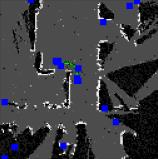
A fully open-source annotation pipeline built using ROS 2, enabling reproducible expert demonstration collection through interactive waypoint selection in a simulated 3D environment.
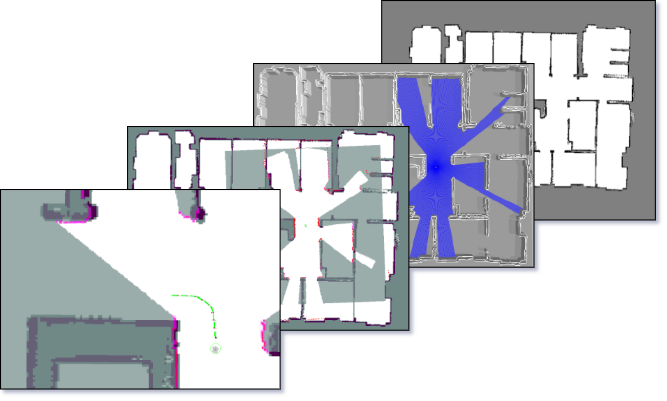
ROS 2 Annotation Tool

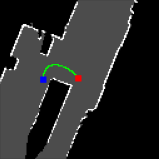
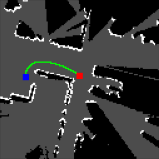
Annotation pipeline: global occupancy grid, 3D environment, local costmap, and path execution.
Key Results

Evaluated across small, medium, and large model architectures with BC, DBC, and Cond-DBC training strategies. The medium Cond-DBC model achieves performance comparable to billion-parameter diffusion models while maintaining real-time inference.

39.1%
Lower APE
vs. large BC baseline
33.5%
Lower FID
vs. large BC baseline
93.8%
Fewer Parameters
Medium Cond-DBC vs. Large BC
~5ms
Inference Time
Real-time on-edge

FID Quality Comparison

High FID (poor quality)
High FID — Poor
High FID (poor quality)
High FID — Poor
Low FID (good quality)
Low FID — Good
Low FID (good quality)
Low FID — Good

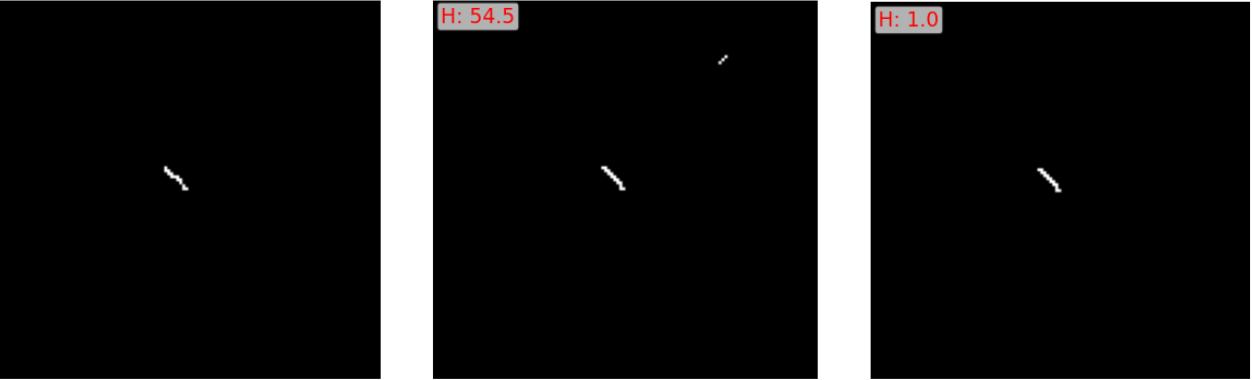
Hausdorff Distance (Artifact Detection)

Hausdorff distance comparison

Ground truth, artifact prediction (Hd 54.5), clean prediction (Hd 1.0)

Resources

GitHub Repository

Source code and training scripts — coming soon

🤗

Expert Dataset

20,000 expert demonstrations — coming soon

🧠

Pretrained Models

BC, DBC, and Cond-DBC weights — coming soon

SKIPP (Prior Work)

The predecessor framework that SPADE extends

Citation

@inproceedings{abihana2026spade,
  author={Abi Hana, Charbel and Ghantous, Tatiana and Khalil, Mikael and Rizk, Anthony},
  title={SPADE: Sketch-guided Path Planning Augmented with Diffusion Experts},
  booktitle={Proc. of the 25th International Conference on Autonomous Agents
             and Multiagent Systems (AAMAS 2026)},
  year={2026},
  address={Paphos, Cyprus}
}